
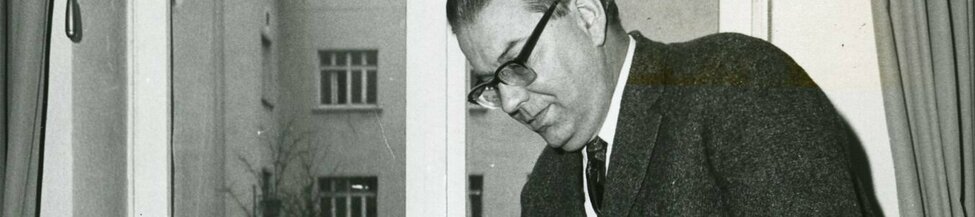
Georg Eckert
Georg Eckert was born in Berlin on 14 August 1912 to left-wing, liberal parents, and was a member of the Socialist Workers’ Youth Party (SAJ) whilst still at school. He enrolled at Friedrich Wilhelms University Berlin in 1931, but the political climate of the Weimar Republic inevitably drew the young Georg Eckert, who became chair of the Socialist Student Body in Berlin in 1932, into open opposition with the National Socialist groups campaigning at the university. As a result, he left the city and enrolled at the University of Bonn in the summer of 1934 to study in the philological faculty. He completed his doctorate in 1935, supervised by the ethnologist Hermann Trimborn. Eckert passed the first state teaching examination in 1936 in the subjects of German, history, geography, pedagogy and ethnology, and passed the second state teaching examination in 1938 in Berlin. During a leave of absence from active military service in 1943, Georg Eckert completed his habilitation thesis on ‘Ancient American Studies’ at Bonn University, qualifying him as a university professor.
In Bonn in 1934, Eckert joined the student division of the SA (Sturmabteilung), as well as the National Socialist Students’ Association (NSDStB) and the ‘Rugia’ fraternity. He also became a member of the Nazi party in 1937. In 1941, following the German occupation of Greece, Eckert was sent to work at the weather station in Thessaloniki as a Wehrmacht officer, becoming the station’s director in September 1942. From this position of authority, Eckert was able to help members of the local population. He prevented many Greeks and Sephardic Jews from being sent to concentration camps and helped others to flee from the German occupation zone into the safer Italian zone. He was also able to prevent the destruction of several villages, planned as retaliatory acts by the Wehrmacht. Through his fieldwork, Eckert also made contact with Greek partisans and, inspired by the attempt on Hitler’s life on 20 July 1944, Eckert and some of his comrades deserted the German army to join the Greek People’s Liberation Army (ELAS). In February 1945 Georg Eckert gave himself up to British troops. The British intended to first take Eckert to London, before sending him back to Germany to help with democratic reconstruction. But on the way there, in Rome, he contracted a life-threatening lung abscess and was transported directly to a military hospital in Goslar where he arrived in August 1945.
As a result of his activities with the Greek resistance and because he remained at the lowest ranks of all National Socialist organisations he entered, he was grouped into category 5 (exonerated) during the allied process of denazification in 1946. In autumn of that year the Braunschweig Premier, Alfred Kubel, brought Eckert, who had since re-joined the SPD, directly from Goslar to the Kant Teacher Training College (Hochschule für Lehrerbilding – Kant Hochschule later the Pädagogische Hochschule) in Braunschweig. As a lecturer in the history and methodology of history teaching – he wasn’t appointed full professor until 1952 – Georg Eckert was committed to developing a democratically focussed teacher training programme. The British military government also entrusted him with writing a new curricula for history teaching, in which he followed his philosophy of enabling young people to form opinions as independently as possible through historical education. This position became a central motif of the Internationales Institut für Schulbuchverbesserung (International Institute for Textbook Improvement), founded in 1951, as well as the international textbook conferences that he initiated and organised, whose aim was to identify hidden, antagonistic stereotypes and prejudices in history and geography textbooks and to contribute to mutual understanding through the revision of these teaching materials
From the mid-1950s onward, Eckert’s primary area of research was the history of the German workers’ movement in the nineteenth century, and he was one of the first West German historians to study the topic during that period. From 1961 onwards, he served as editor of the Jahrbuch der Friedrich Ebert-Stiftung ‘Archiv für Sozialgeschichte’ (Yearbook of the Friedrich-Ebert-Stiftung: Archive of Social History), which he founded, but the majority of his time and energy after 1949, and certainly after 1951, was taken up with the Internationale Schulbuchinstitut (International Textbook Institute) which he directed in a voluntary capacity. He also became president of the German UNESCO Commission in 1964
Georg Eckert died on 7 January 1974, at the age of 61, during a lecture on the history of the workers’ movement.
